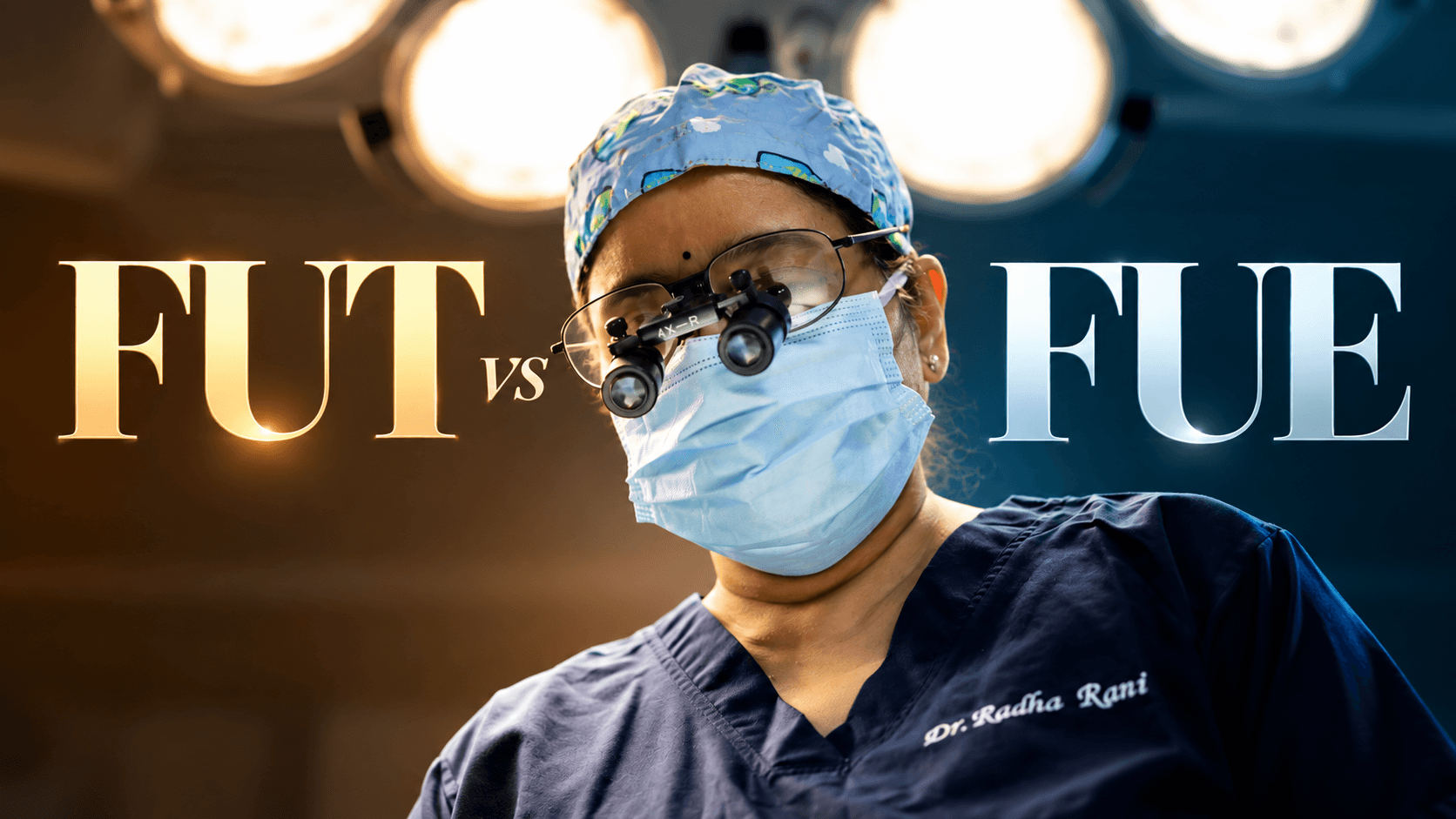

Is the surgeon performing your hair transplant actually qualified?
In India, hair transplant surgery is largely unregulated. Anyone can call themselves a "hair transplant expert" and with enough marketing spend, plenty do. The claim has become cheap.
Now aesthetic clinics with no qualified surgeon in the room offer hair transplants routinely. Some aren't even hair clinics dental setups have started performing transplants, hiding behind the word "aesthetic." And it shows. Failed Hair Transplants, Unnatural hairlines, patchy growth, grafts wasted in places they'll never grow back the kind of result that takes years to fix, if it can be fixed at all and affects the patients mental health.
So here's the question worth asking before anything else: what actually separates a qualified hair transplant surgeon from a good marketing budget? The answer comes down to two certifications most patients have never heard of — ISHRS and ABHRS.
Why does hair transplant surgery need real certification?
It's easy to forget, but a hair transplant is surgery. It involves incisions, extraction of living tissue, local anaesthesia, and thousands of grafts placed one by one across your scalp. Done well, the result lasts a lifetime. Done badly, it is one of the hardest cosmetic outcomes to fix.
That is the part most marketing never mentions. A poorly done transplant does not just fail to grow. It can leave an unnatural hairline, patchy density, visible scarring, and donor grafts wasted in places they will never grow back. Grafts are a finite resource. Once they are taken and placed badly, the raw material for a proper correction may simply be gone.
This is where certification stops being a formality and starts being protection. The bodies that certify hair transplant surgeons exist for one reason: to confirm that the person holding the instruments has actually proven they can do this safely and well. In fact, the leading board in the field treats the core surgical steps as non delegable, meaning the creation of extraction and graft placement incisions must be performed by the physician, not passed to a technician.
That single principle explains why credentials matter so much in this specific procedure. The question is never just "is this clinic good at marketing." The question is "who is actually going to perform my surgery, and have they proven they can." A certified hair transplant surgeon has an answer to that. An unregulated clinic is hoping you will not ask.
What is ABHRS Certification? (Diplomate status)
The American Board of Hair Restoration Surgery (ABHRS) is internationally recognized as the only board certification focused solely on hair restoration surgery. Becoming a Diplomate of the ABHRS isn't something a doctor can buy or claim, it has to be earned. A surgeon must show three years of documented safe practice, submit 150 surgical case logs and 50 operative reports with before-and-after photos, and then pass both written and oral examinations. It's the only psychometrically validated exam dedicated to hair restoration surgery. Abhrs + 3
Here's what that means for you as a patient: A Diplomate has had their actual results judged by an independent board of international experts — not marketed, proven. And it's rare. Approximately there are only 270 ABHRS Qualified Hair Transplant Surgeons.
What does ISHRS Fellowship (FISHRS) actually mean?
The International Society of Hair Restoration Surgery (ISHRS) is a global non-profit medical society of over 1,200 members across more than 80 countries. Being a member is a baseline, Any one can pay the membership fee and call themselves a “member:. Being a Fellow (FISHS) is a different thing entirely. It's earned through a competitive, point-based scorecard through leadership, ABHRS certification, peer-reviewed publications, and teaching other surgeons not by paying annual dues. ISHRS + 2
Why holding both is genuinely rare
Most hair transplant surgeons hold neither of these. Many hold one. Almost none hold both and the numbers show why. Out of more than 1,200 ISHRS members worldwide, only around 270 surgeons have earned ABHRS Diplomate status fewer than one in four. Layer the FISHRS Fellowship on top of that, and you're looking at a very small group of surgeons globally. Charles, GlennCharles, Glenn
Dr. Radha Rani is one of them: a Diplomate of the ABHRS and a Fellow of the ISHRS and India’s First Certified Hair Transplant Surgeon.
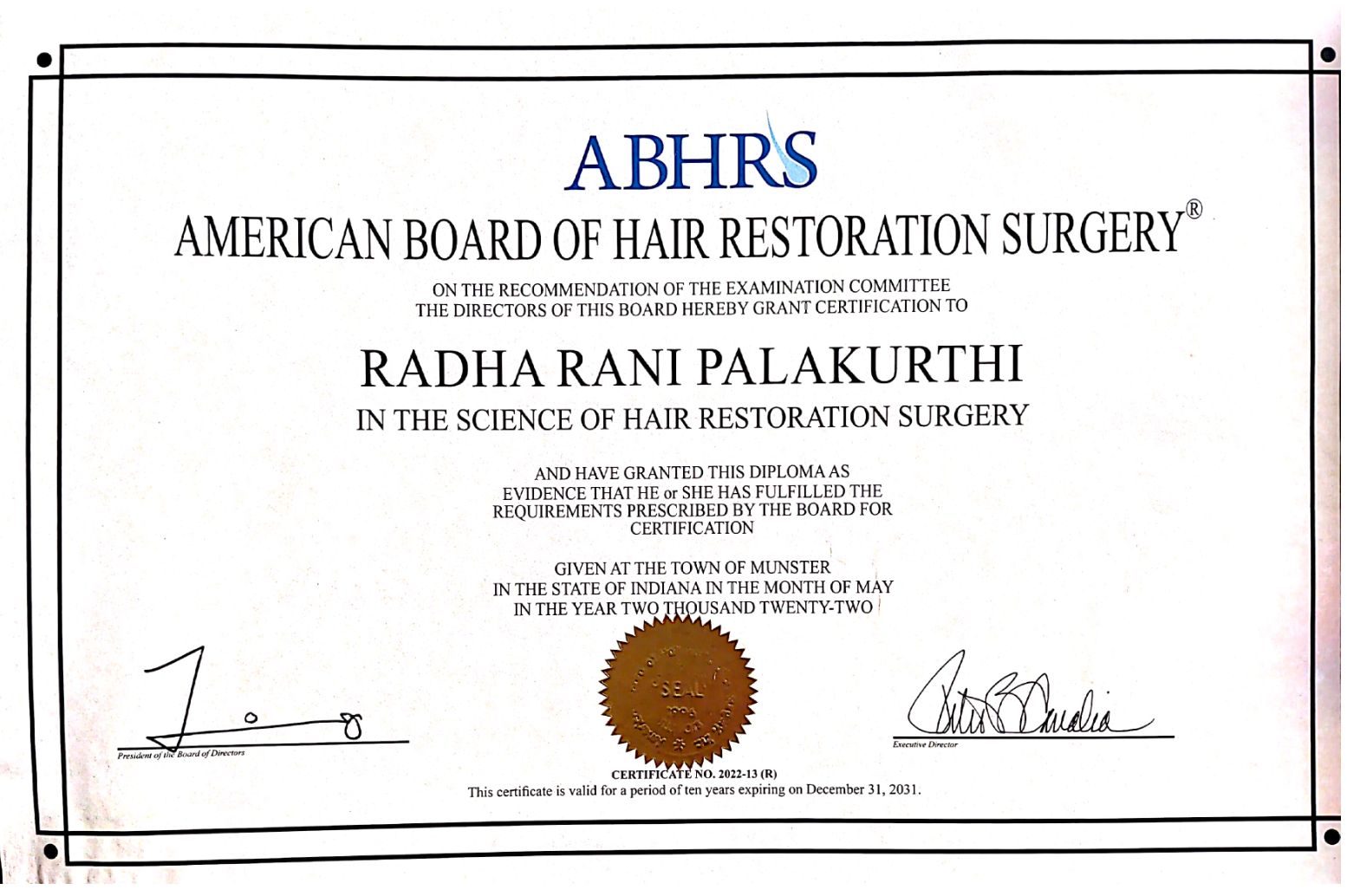
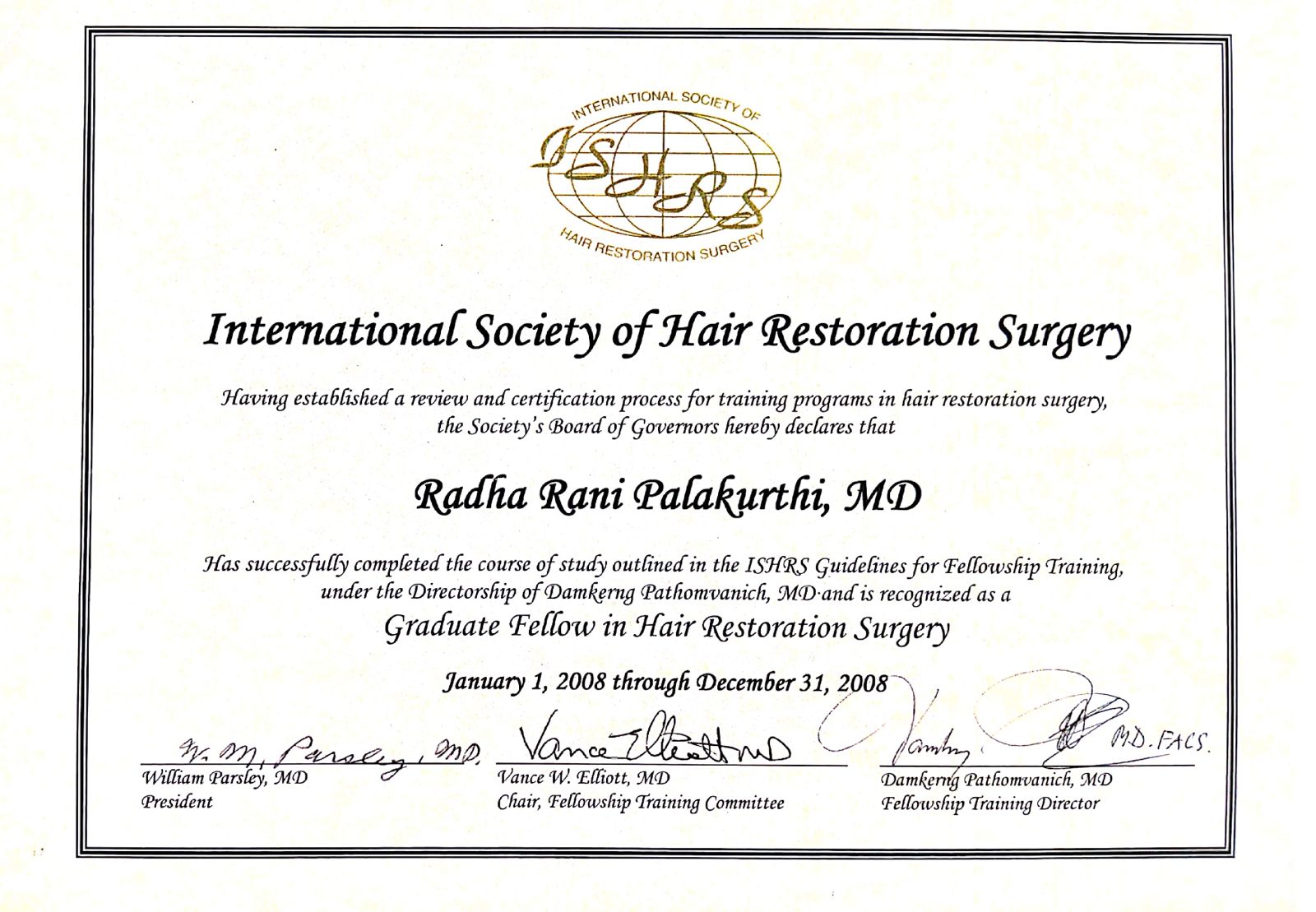
Meet Dr.Radha Rani, Diplomate ABHRS & FISHRS,
Dr.Radha Rani is not only certified by both, she has the honor of becoming India’s first certified Hair Transplant Surgeon with Dual degrees from ISHRS & ABHRS. She is trained by the best surgeons in the world like Father of Asian Hair Transplant, Pioneer of Open Technique Dr.Damkerng Pathomvanich. She has performed over 5000+ Hair Transplants in the last 17 to 18 years. She performs every single surgery by herself.
Dr. Radha Rani doesn't just hold one of these credentials. She holds both - a Diplomate of the American Board of Hair Restoration Surgery and a Fellow of the ISHRS and she was India's first certified hair transplant surgeon: CONFIRM exact wording. Very few surgeons in the world hold both.
She is trained by Dr. Damkerng Pathomvanich, globally know as The Father of Asian Hair Transplant and Pioneer of Open Technique. Over the last 17 years, she has performed more than 5,000 hair transplants and she performs every surgery by herself in her clinic.
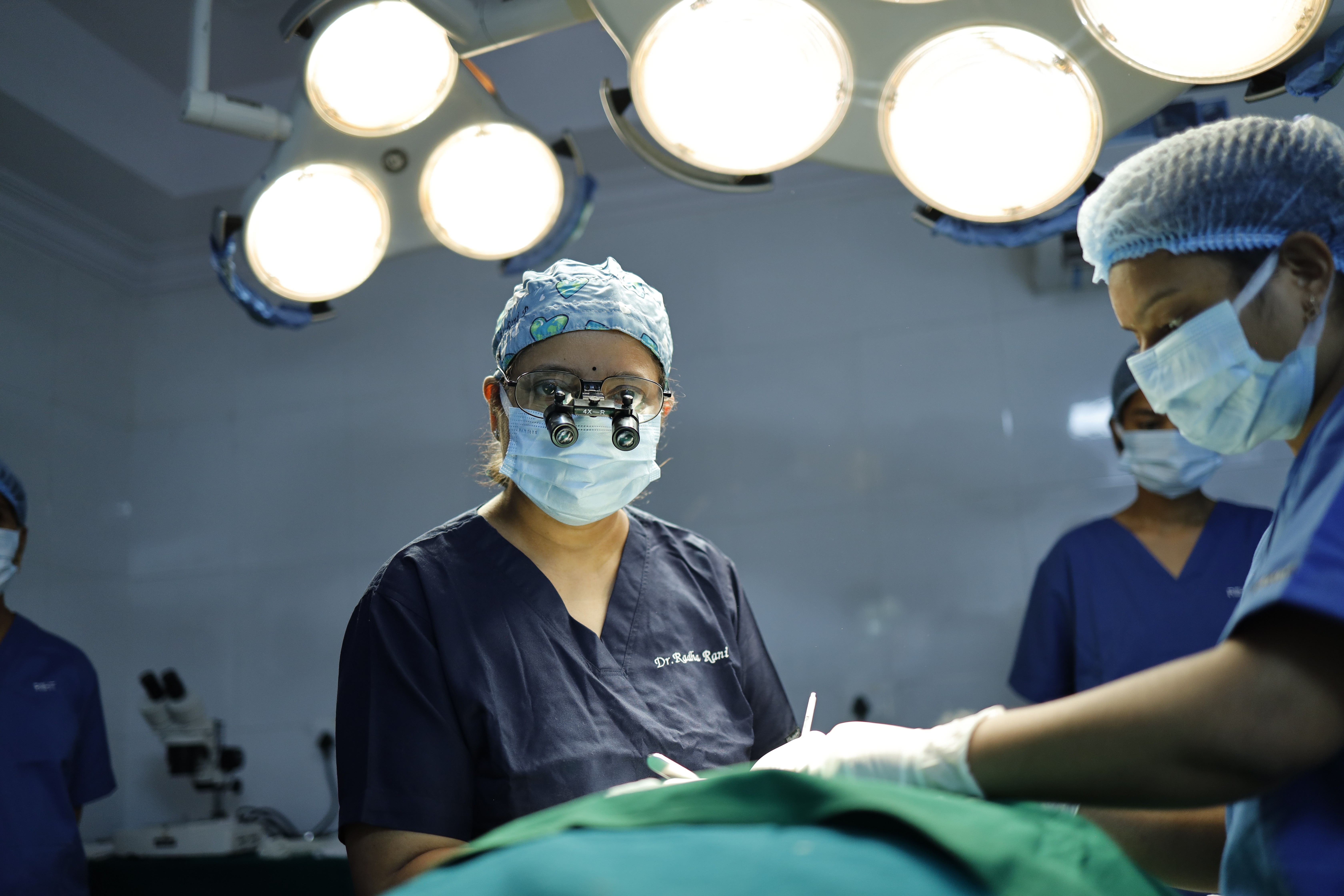

How to Verify a Hair Transplant Surgeon's Certification in India
Here's the good news. You don't have to take any clinic's word for it, including ours. Both certifying bodies keep public directories, and anyone can search them in under a minute.
Check the ABHRS directory. The American Board of Hair Restoration Surgery lists every current Diplomate on its official website (abhrs.org). If a surgeon claims to be ABHRS certified, their name should appear there. If it doesn't, that's your answer. One thing worth knowing: the correct term is "Diplomate of the ABHRS," not "board certified by ABHRS." A clinic using the wrong phrasing may not fully understand the credential it is claiming.
Check the ISHRS directory. The International Society of Hair Restoration Surgery (ishrs.org) lists its members and Fellows. Remember the distinction covered earlier: being a member is a baseline, while being a Fellow (FISHRS) is the highest recognition the society gives. Both show in the directory, so you can see exactly which level a surgeon holds.
Ask one direct question. If you are sitting in a consultation, ask plainly: "Will you personally perform my surgery, and are you an ABHRS Diplomate?" A qualified surgeon will answer both without hesitation. Watch how the question lands. The reaction often tells you as much as the answer.
Why this matters more in India. Because hair transplant is largely unregulated here, verification is the one tool that actually protects you. Marketing can claim anything. A directory listing cannot be faked. When you are choosing a certified hair transplant surgeon in Vizag, or anywhere, five minutes of checking is the cheapest insurance you will ever buy.
Frequently Asked Questions
1. Is hair transplant regulated in India?
Hair transplant surgery is largely unregulated in India, which means there is no single authority stopping unqualified clinics from offering it. This is exactly why independent certifications like ABHRS and ISHRS matter. They are the only reliable way to confirm a surgeon has proven their skill rather than just claimed it.
2. What does ABHRS certification mean?
ABHRS stands for the American Board of Hair Restoration Surgery, the only board certification focused solely on hair restoration. To become a Diplomate, a surgeon must document years of safe practice, submit surgical case logs and operative photos, and pass written and oral exams. It is the strongest proof that a surgeon's actual results have been judged by independent experts.
3. How do I know if my hair transplant surgeon is qualified?
Check whether the surgeon appears in the public ABHRS and ISHRS directories, which anyone can search online. Then ask one direct question: will they personally perform the surgery, or will it be handed to technicians. A qualified, certified surgeon will answer both openly.
4. Are all hair transplant doctors certified?
No. Most hair transplant procedures in India are performed without any specialist certification, and some are carried out by staff who are not qualified surgeons at all. Certification such as ABHRS Diplomate or ISHRS Fellowship is rare, which is exactly what makes it worth looking for.
5. What is the difference between ISHRS membership and FISHRS Fellowship?
ISHRS membership is a baseline that a licensed doctor can hold, while FISHRS (Fellow) is the highest recognition the society gives, earned through a points-based record of leadership, teaching, and contribution to the field. Many clinics blur the two by simply claiming "ISHRS affiliation." Knowing the difference helps you tell a genuine expert from a paid-up member.
Your surgeon's credentials are the one thing worth checking twice
A hair transplant is a decision you live with every day after. The technique matters, the clinic matters, but the single most important question is who is actually holding the instruments, and whether they have proven they can do this well.
Dr. Radha Rani has spent 17 years answering that question the hard way, through certification, through thousands of surgeries performed personally, and through results you can verify for yourself. When you are ready, that is where to start.
Book your consultation. Call +91 92468 79495 or submit your details here