
The Norwood Scale: 7 Stages of Male Pattern Baldness & Treatment Guide
International Institute of Hair Transplant
- IIHT by Dr. Radha Rani
Medically Reviewed by Dr. Radha Rani | Diplomate ISHRS & ABHRS | Best Hair Transplant Surgeon
Male pattern baldness (Androgenetic Alopecia) follows a predictable, progressive pattern. The Hamilton-Norwood Scale is the internationally recognized clinical benchmark used by hair restoration surgeons to diagnose the severity of hair loss, predict future miniaturization, and design permanent surgical restoration plans.

Stage
Norwood 1
Norwood 2
Norwood 3
Norwood 3 vertex
Norwood 4
Norwood 5
Norwood 6
Norwood 7
Hairline
Full juvenile hairline
Slight recession at the temples, a mature hairline
Clear M, V or U shaped recession at both temples
Stage 2 or 3 hairline
Deeper recession at the front
Larger frontal loss
Front and crown have joined, the band is gone
Loss across the whole top of the scalp
Stage
Norwood 1
Norwood 2
Norwood 3
Norwood 3 vertex
Norwood 4
Norwood 5
Norwood 6
Norwood 7
Hairline
Full juvenile hairline
Slight recession at the temples, a mature hairline
Clear M, V or U shaped recession at both temples
Stage 2 or 3 hairline
Deeper recession at the front
Larger frontal loss
Front and crown have joined, the band is gone
Loss across the whole top of the scalp
Stage
Norwood 1
Norwood 2
Norwood 3
Norwood 3 vertex
Norwood 4
Norwood 5
Norwood 6
Norwood 7
Crown
Full
Full
Full
Early thinning or a small bald patch
Visible bald or thinning patch, still separated from the front by a band of hair
Larger crown loss, the dividing band is narrowing
Merged with the front
None
Stage
Norwood 1
Norwood 2
Norwood 3
Norwood 3 vertex
Norwood 4
Norwood 5
Norwood 6
Norwood 7
Crown
Full
Full
Full
Early thinning or a small bald patch
Visible bald or thinning patch, still separated from the front by a band of hair
Larger crown loss, the dividing band is narrowing
Merged with the front
None
Stage
Norwood 1
Norwood 2
Norwood 3
Norwood 3 vertex
Norwood 4
Norwood 5
Norwood 6
Norwood 7
Is this balding?
No
No
Yes, the first true balding stage
Yes
Yes
Yes
Yes
Yes
Stage
Norwood 1
Norwood 2
Norwood 3
Norwood 3 vertex
Norwood 4
Norwood 5
Norwood 6
Norwood 7
Is this balding?
No
No
Yes, the first true balding stage
Yes
Yes
Yes
Yes
Yes
Stage
Norwood 1
Norwood 2
Norwood 3
Norwood 3 vertex
Norwood 4
Norwood 5
Norwood 6
Norwood 7
Typical graft range
Not applicable
800 to 1,500 if treated
1,500 to 2,500
2,000 to 3,000
2,500 to 3,500
3,000 to 4,500
4,000 to 6,000
Limited by donor supply
Stage
Norwood 1
Norwood 2
Norwood 3
Norwood 3 vertex
Norwood 4
Norwood 5
Norwood 6
Norwood 7
Typical graft range
Not applicable
800 to 1,500 if treated
1,500 to 2,500
2,000 to 3,000
2,500 to 3,500
3,000 to 4,500
4,000 to 6,000
Limited by donor supply

Norwood 1 and 2
Your hairline has moved back slightly at the temples but nothing is thinning. In most men this is a hairline maturing with age, not balding.
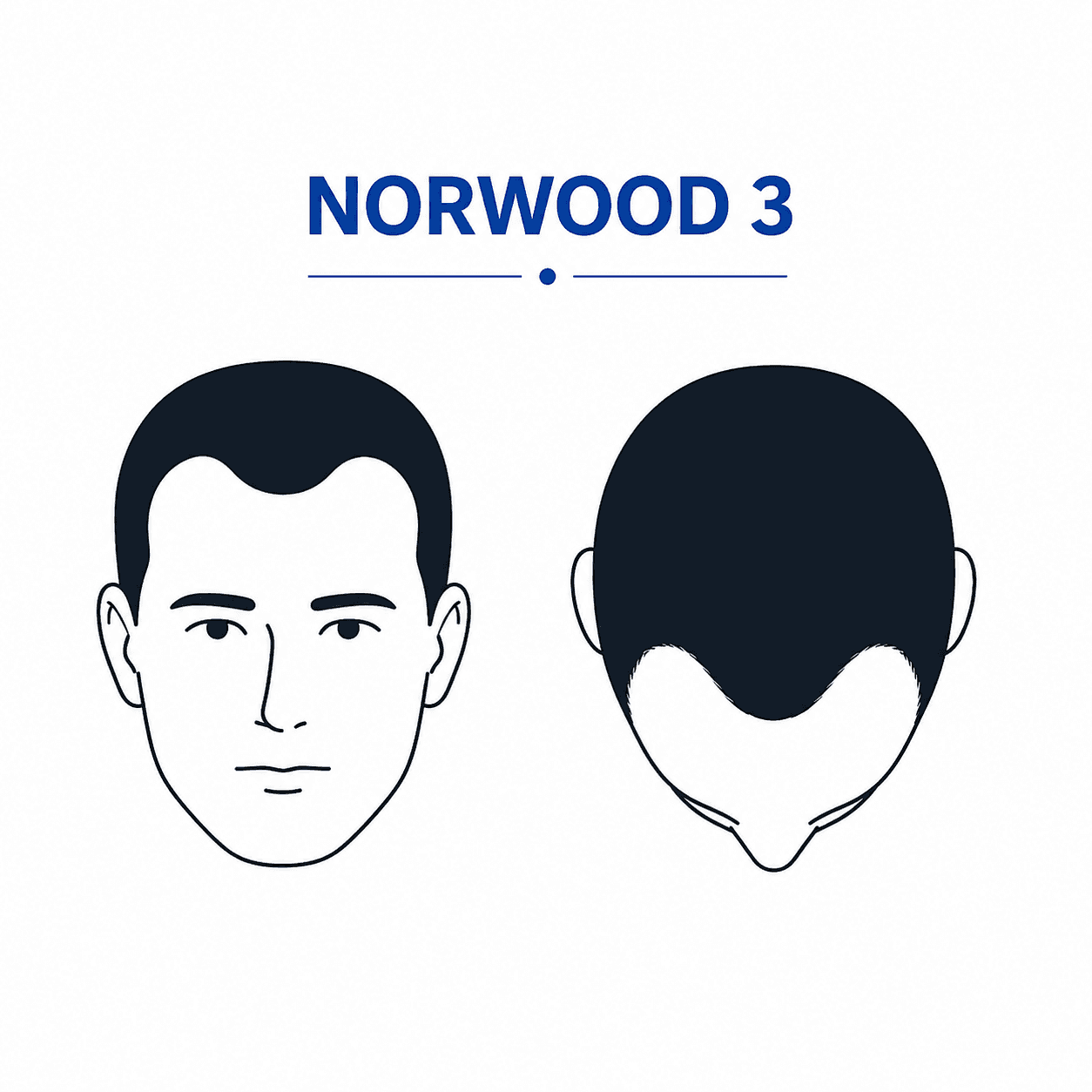
Norwood 3
Both temples have receded into a clear M, V or U shape. This is the first stage the scale counts as genuine baldness.

Norwood 3 vertex
Temple recession plus early thinning at the crown. Two separate zones, which changes the surgical plan entirely.
Norwood 4
Deeper frontal loss with a clear bald patch at the crown, still separated by a band of hair across the top.
Norwood 5
Both areas have grown and the band of hair dividing them is beginning to break down. Donor planning becomes the main question here.
Norwood 6
The dividing band has gone. The front and crown are now one continuous bald area.
Norwood 7
Only a band of hair remains around the sides and back. Options depend almost entirely on what that donor band can supply.
Type A variants
In Type A patterns the whole front hairline recedes back in one line and the crown is spared. Less common, and it needs a different hairline design.