
Norwood 3 Vertex: Why the Crown Changes the Plan
Norwood 3 vertex is temple recession combined with early thinning or a small bald patch at the crown. The hairline may look like a Norwood 2 or Norwood 3, but the crown is now involved as well. That means two separate zones of hair loss rather than one, which changes the graft count, the treatment order, and often whether surgery is the right step at all.
Medically reviewed by Dr. Radha Rani, ABHRS and ISHRS certified hair restoration surgeon. 17 years in hair restoration, 5,000+ procedures.

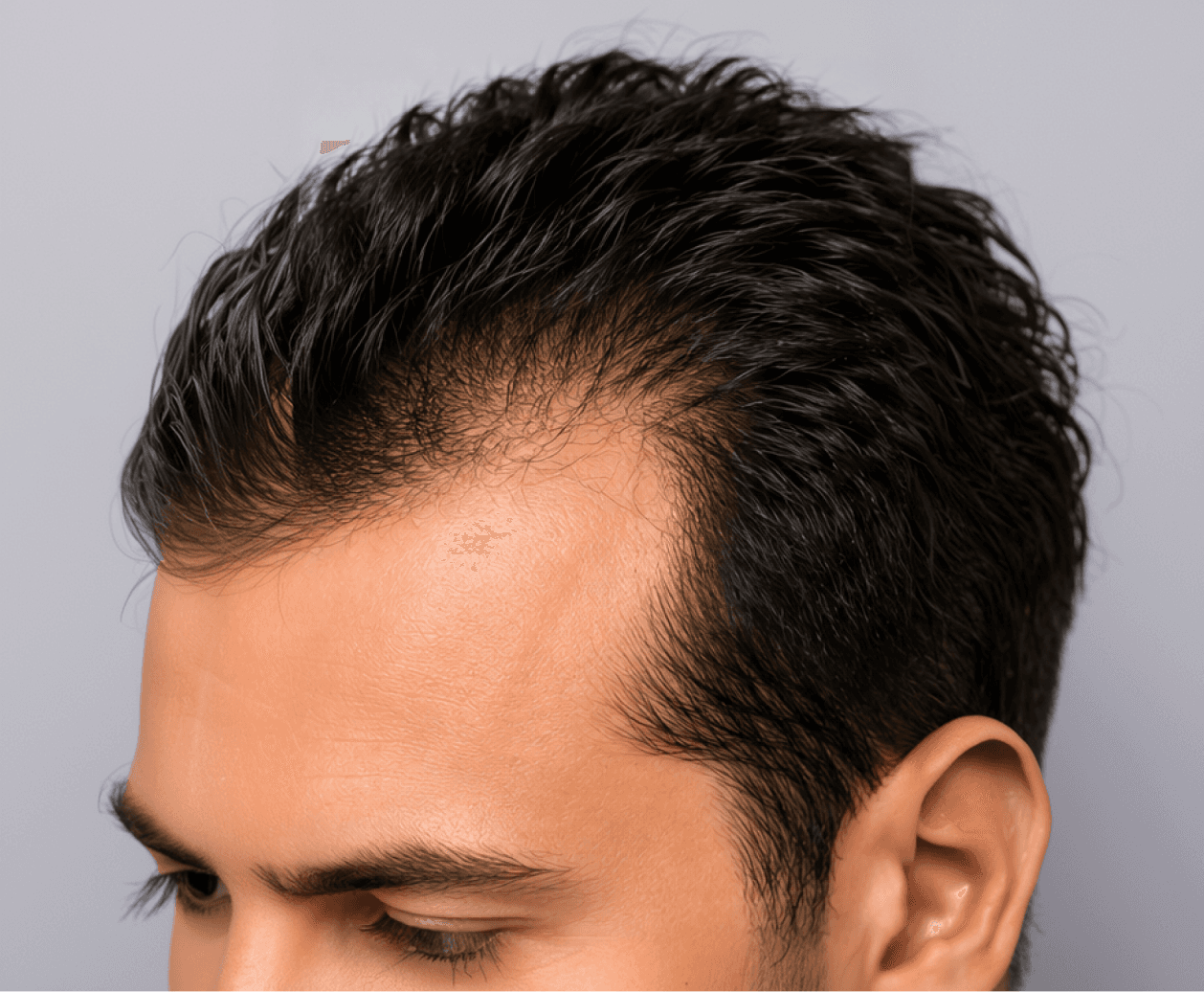
Norwood 3 vertex: recession at the temples plus early crown involvement. The crown is only visible from above. See the full Norwood scale.
What Norwood 3 vertex looks like

The hairline
Recession at both temples, forming the familiar M, V or U shape. In some men the hairline at this stage is barely past a mature hairline and looks closer to a Norwood 2. The hairline is not what defines this stage.
The crown
This is what defines it. At the vertex, the whorl at the back of the top of the head, hair has started to thin. In the earliest presentation it is diffuse thinning where the scalp shows through under bright light. Later it becomes a defined circular patch that widens outward from the whorl.
Critically, this is almost invisible from the front or in a mirror. It is the reason a large number of men place themselves at Norwood 3 when they are actually at 3 vertex, and it only shows in a photograph taken from directly above.

The bridge
Between the receding hairline and the thinning crown there is still a solid, well-covered band of hair across the top of the head. That band is intact at this stage. When it starts breaking down, the stage has moved on toward Norwood 4 and beyond.
Norwood 3 or Norwood 3 vertex?
The distinction is not cosmetic. It changes the surgical plan, the graft count, and the advice you should be given.
Norwood 3
Norwood 3 vertex
Hairline
Deep temple recession
Temple recession, sometimes milder
Crown
Fully covered
Thinning, or a defined patch
Zones of loss
One, at the front
Two, front and crown
Visible from the front?
Yes
The front is, the crown is not
Typical graft range
1,500 to 2,500
2,000 to 3,000
Usual first step
Stabilise, then consider surgery
Stabilise, and often treat the crown medically rather than surgically
How to check
Hold your phone above your head, camera facing down, and take a photo in daylight. Look at the whorl at the back of the top of your head. If you can see scalp through the hair there, or a defined patch, the crown is involved.
Do this before any consultation, and bring the photo. It is the single most useful thing you can arrive with, and most men have never taken it.
How Norwood 3 vertex progresses
Crown loss behaves differently from hairline loss, and understanding that difference is what makes the treatment decisions below make sense.
A receding hairline moves backwards along a front. A thinning crown expands outwards in a circle from the whorl. Because the area of a circle grows with the square of its radius, a crown patch that doubles in width covers roughly four times the area. Crown loss that looks minor can become substantial faster than the early stages suggest.
Left untreated, most men at Norwood 3 vertex progress toward Norwood 4 over a period of years, with the crown patch widening and the frontal recession deepening. The bridge of hair between the two areas is usually the last thing to go.
Rate varies enormously between individuals. Faster progression is associated with onset before 25, a strong family history of advanced baldness, and visible acceleration over the past year or two.
How many grafts does Norwood 3 vertex need?
Treating both zones at Norwood 3 vertex typically needs roughly 2,000 to 3,000 grafts, though in many cases only the frontal zone should be treated surgically.
That second clause matters more than the number. The graft range assumes you are restoring both the hairline and the crown. Frequently the better plan is to restore the hairline surgically, at roughly 1,500 to 2,500 grafts, and manage the crown medically.
What moves the number:
The size of the crown patch. The crown is a large surface area and it consumes grafts quickly, which is why treating it materially raises the total.
Donor density. Higher density at the back and sides means more grafts available. The crown competes directly with the hairline for that finite supply.
Hair characteristics. Coarse, wavy hair gives more visual coverage per graft, which matters most in the crown where full density is rarely achievable.
How much of the budget goes to the front. This is a genuine trade-off, not a technicality. Grafts spent on the crown are grafts unavailable for the hairline later.
Any graft figure quoted before your donor area has been examined under magnification is an estimate. At Norwood 3 vertex, that estimate is less reliable than at other stages, because the right plan may not involve treating both zones at all.
Should you transplant the crown at all?
For a lot of men at Norwood 3 vertex, particularly younger men, the honest answer is no. Not yet, and possibly not ever.
Here is the reasoning, and it is worth understanding rather than just accepting.
The crown keeps expanding. Hairline recession tends to slow and settle at a certain point. Crown loss keeps widening outwards for as long as the underlying process is active. Transplanting into the middle of something that is still growing is a difficult bet.
A transplanted crown can become an island. If the crown is filled at 26 and the surrounding native hair continues to thin over the next fifteen years, the transplanted patch stays while everything around it goes. The result is a visible disc of hair inside a bald area, which looks worse than the crown loss would have on its own, and it is very difficult to correct.
The crown is expensive in grafts and modest in return. It is a large, curved surface where hair grows in a whorl pattern, which makes achieving convincing density harder than at the hairline. It consumes a large share of a finite donor supply for a zone that most people see far less often than your face.
The front frames your face. The crown does not. In terms of how you appear to other people in ordinary interaction, the hairline does most of the work. Given a limited donor supply, spending it on the front is usually the better investment.
The general position among experienced hair restoration surgeons is that the crown should not be transplanted in a younger man with an unstable pattern. Stabilise it medically, protect the donor supply, and revisit the crown later, if at all, once the pattern has settled.
None of this means the crown can never be treated. In an older man with a settled pattern, good donor density, and realistic expectations about achievable density, crown restoration can work well. The distinction is age and stability, not the Norwood number.
If a clinic looks at a 26 year old at Norwood 3 vertex and proposes filling both zones in one session without discussing any of this, that is worth weighing carefully.
Treatment options at Norwood 3 vertex
Medical treatment, and especially for the crown
Medical treatment is the first step at this stage, and it is particularly relevant here because the crown tends to respond better to medication than the frontal hairline does. For many men at Norwood 3 vertex, medication alone produces a meaningful improvement in crown density and, more importantly, holds it.
That combination, medication for the crown and surgery for the front, is a very common and very sensible plan at this stage.
PRP and GFC
PRP therapy and GFC therapy are used alongside medication to support existing follicles, which is relevant at the crown where a good deal of hair is miniaturising rather than gone.
Hair transplantation, usually front first
Where surgery is appropriate, FUE suits Norwood 3 vertex well. The usual approach is to restore the frontal hairline and temple areas, design conservatively with future loss in mind, and hold the crown in reserve.
A transplant does not stop hair loss.
Transplanted hair comes from an area genetically resistant to thinning, so it stays. Everything around it does not. At Norwood 3 vertex this matters twice over, because there are two active zones. Without medical treatment running alongside, native hair keeps receding around whatever is transplanted. This is the most common reason men need a second corrective procedure.
Norwood 3 vertex FAQs
What is the difference between Norwood 3 and Norwood 3 vertex?
Norwood 3 is temple recession with a fully covered crown. Norwood 3 vertex adds thinning or a bald patch at the crown, so there are two separate zones of loss. That raises the graft count and usually changes the treatment order.
How many grafts do I need for Norwood 3 vertex?
Roughly 2,000 to 3,000 if both the hairline and crown are treated surgically. In many cases the better plan is to restore only the hairline, at around 1,500 to 2,500 grafts, and manage the crown with medication.
Should I get a hair transplant on my crown?
Often not, especially if you are under about 35 with an unstable pattern. Crown loss keeps expanding, so a transplanted crown can end up isolated inside a widening bald area. Stabilising medically and revisiting later is usually the wiser approach.
Can crown thinning be reversed?
Partially, in many cases. The crown tends to respond better to medical treatment than the frontal hairline, and hair that is miniaturising rather than gone can thicken meaningfully. Follicles that have already been lost do not return.
How do I check if my crown is thinning?
Take a photo from directly above your head in daylight, camera facing down. Look at the whorl at the back of the top of your head. Scalp visible through the hair, or a defined patch, means the crown is involved. It is not reliably visible in a mirror.
Is crown thinning at 25 bad?
It means the process started early, and early onset predicts a higher eventual Norwood stage. It does not mean surgery is urgent. It usually means medical treatment should start now and any surgery should be planned conservatively.
How fast does Norwood 3 vertex progress?
It varies from a few years to well over a decade. Crown loss expands outward in a circle, so the affected area can grow faster than the early stages suggest. Faster progression is associated with onset before 25 and a strong family history.
Will finasteride help my crown?
Medical treatment is generally more effective at the crown than at the frontal hairline, which is one reason a medication-first approach makes sense at this stage. Whether it is appropriate for you is a decision for a doctor who has examined you.
What does a Norwood 3 vertex hair transplant cost in India?
Cost is driven by graft count rather than Norwood stage. Because the plan may involve treating one zone or two, the range is wider here than at other stages, and an assessment is the only way to get an accurate figure.
Get assessed by Dr.Radha
At Norwood 3 vertex the central question is not how many grafts you need. It is whether the crown should be treated surgically at all, and that cannot be answered from a photograph.
An assessment establishes donor density under magnification, how much of the crown is miniaturising rather than lost, whether the pattern looks stable or still active, and what a finite donor supply can realistically cover across two zones over a lifetime rather than in one procedure.
Dr. Radha Rani is certified by the American Board of Hair Restoration Surgery and a member of the International Society of Hair Restoration Surgery, with 17 years in hair restoration and over 5,000 procedures. Consultations are available in person in Visakhapatnam and online for patients travelling from elsewhere in India or overseas.


Reviewed by Dr. Radha Rani
Dr. Radha Rani is a hair restoration surgeon based in Visakhapatnam with 17 years in hair transplantation and 25 years in dermatology. She is certified by the American Board of Hair Restoration Surgery and a member of the International Society of Hair Restoration Surgery, and trained under Dr. Damkerng Pathomvanich. She has performed over 5,000 procedures for patients from more than 20 countries.
At IIHT, transformation isn’t just about restoring hair — it’s about restoring you.Take the first step toward a more confident tomorrow.
