
Norwood 1 and 2: Mature Hairline or Early Hair Loss?
Norwood 1 and Norwood 2 are the two stages of the Norwood scale that are not classified as balding. Norwood 1 is a full juvenile hairline sitting low on the forehead. Norwood 2 is a mature adult hairline, which sits slightly higher with a gentle recession at the temples. This change happens to most men between their late teens and late twenties and it is normal. Balding starts at Norwood 3.
Medically reviewed by Dr. Radha Rani, ABHRS and ISHRS certified hair restoration surgeon. 17 years in hair restoration, 5,000+ procedures.

Left: Norwood 1, a juvenile hairline. Right: Norwood 2, a mature hairline. Neither is classified as balding. See the full Norwood scale.
What Norwood 1 and 2 look like

Norwood 1: the juvenile hairline
The hairline runs in a straight or gently curved line low across the forehead, usually resting close to the top forehead crease. The temple corners are full and square. There is no recession anywhere and no thinning at the crown.
This is the hairline most men have through adolescence. It is worth knowing that a juvenile hairline is not the adult baseline. Almost nobody keeps it for life, and losing it is not the start of balding.
Norwood 2: the mature hairline
[H3] Norwood 2: the mature hairline
The hairline has moved back slightly, sitting roughly one finger width, about 1.5 cm, above the highest crease on your forehead. The temple corners have rounded off into shallow, symmetrical recessions. The centre of the hairline stays forward.
The crown is untouched, the density behind the hairline is unchanged, and the whole change is subtle enough that most people who know you will not have noticed.


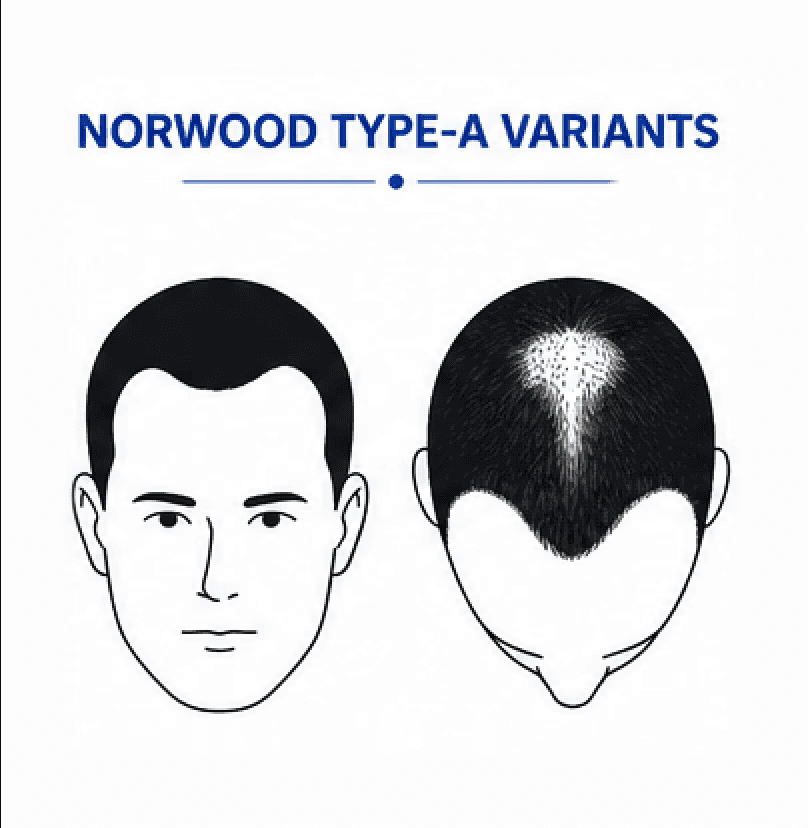
Norwood 2A
In the Type A variant, the whole hairline moves back evenly in one line rather than receding at the corners. It is less common and it follows a different pattern later on. See Norwood Type A variants.
Mature hairline or receding hairline?
This is what almost everyone on this page is actually asking, and there is a reliable way to answer it.
A mature hairline is an event. It happens over a few years, it settles, and then it stops. A receding hairline is a process. It keeps going.
That means the single most useful diagnostic tool you have is not a mirror. It is old photographs.
Mature hairline (Norwood 2)
Receding hairline (Norwood 3+)
Position
About 1.5 cm above the brow crease
Well past that
Temple corners
Shallow, rounded, symmetrical
Deep, triangular, clearly defined
Over 3 to 5 years
Settles, then stays the same
Keeps moving back
Behind the hairline
Density unchanged
May be thinning or miniaturising
Crown
Unaffected
May show thinning
Noticed by others
Rarely
Yes, visible in conversation
The photo test
Find photos of yourself from three years ago and five years ago, taken from the front with your hair back off your forehead. Line them up against a photo taken today in similar lighting.
If the hairline moved once and then held, that is maturation. If it has moved in each photo, that is progression, and you are heading toward or already at Norwood 3.
Bathroom mirrors and overhead lighting make temples look worse than they are. Shadows fall directly into the recessions. If you are assessing your own hairline, do it in daylight facing a window, and compare photos rather than memory. Memory of your own hairline is unreliable, and anxiety makes it more so.
When Norwood 1 or 2 is worth
taking seriously
Most men at these stages need nothing at all. There are a few genuine exceptions where an assessment is reasonable, and they are not about the hairline position itself.
Thinning behind the hairline or at the crown. The hairline position may be normal, but diffuse thinning is not part of maturation. Take a photo from directly above to check the crown.
Your hairline has moved in each of the last few years. Maturation settles. Continued movement is progression.
Onset before 20. Early onset is the strongest single predictor of eventually reaching an advanced stage, so it is worth establishing a baseline even if nothing needs treating yet.
A strong family history of advanced baldness. Particularly where relatives reached Norwood 5, 6 or 7 relatively young.
Sudden or heavy shedding. Losing noticeably more hair over weeks rather than years is not pattern hair loss, and it may point to something else entirely, such as telogen effluvium, thyroid dysfunction or iron deficiency. Those are worth investigating because several are reversible.
If none of these apply to you, the reasonable thing to do is nothing, and check again in a year with a photograph.
What to do at Norwood 1 and 2
In most cases: monitor
Take a front-on photo and a top-down photo once a year, in daylight, hair pulled back. Keep them. That five-minute habit will answer, definitively, a question that otherwise causes years of uncertainty. It is also the single most useful thing you can bring to a consultation later, if you ever need one.
If one of the flags above applies: get a baseline assessment
Not to start treatment, but to establish what your hair is actually doing. An assessment can identify miniaturisation under magnification long before it is visible in the mirror, and it can rule out non-pattern causes.
If loss is confirmed to be progressing: stabilise early
Where hair loss is genuinely underway, medical treatment is more effective at this point than at any later stage, because protecting hair you still have is far easier than replacing hair you have lost.
You should not have a hair transplant at Norwood 1 or 2.
There is nothing to restore. Surgery on a maturing hairline means transplanting into an area that was never going to be bald, using donor hair that is finite and may be needed genuinely later. It also risks an unnaturally low hairline that ages badly. Any clinic willing to operate at these stages is not planning for the rest of your life.
Most men who worry about Norwood 2 are not balding
A large share of the men who look up the Norwood scale are in their late teens or early twenties, have noticed their hairline is not where it was at fifteen, and have concluded they are going bald. Most of them are not.
The juvenile hairline is a temporary feature of adolescence, not a permanent baseline. Losing it is a normal part of becoming an adult, and comparing your hairline to your school photographs will make almost any healthy adult man look like he is receding.
Hair loss is also the one health worry that gets checked several times a day in a mirror, which is a reliable way to convince yourself something is changing when it is not. If you are photographing your hairline weekly, you will see change that is not there, because lighting, hair length, and how recently you washed it all change how a hairline reads.
The useful position at Norwood 2 is neither denial nor alarm. It is a photograph once a year and getting on with your life. If it is progressing, a year of monitoring costs you very little, because pattern hair loss moves slowly and the treatments that work are just as effective a year from now. If it is not progressing, you will have saved yourself years of anxiety.
If you have read this far hoping for a reason to act, the honest one is short: act if there is thinning behind the hairline, if the crown is involved, or if it has moved every year. Otherwise, do not.
Norwood 1 and 2 FAQs
Is Norwood 2 balding?
No. Norwood 2 describes a mature adult hairline, which is a normal change that happens to most men between their late teens and late twenties. The Norwood scale classifies balding as beginning at stage 3.
What is the difference between Norwood 1 and Norwood 2?
Norwood 1 is a full juvenile hairline sitting low on the forehead with square temple corners. Norwood 2 is a mature hairline sitting about 1.5 cm higher, with shallow rounded recessions at the temples. Neither is balding.
Is a receding hairline at 20 normal?
A slight recession at the temples in your late teens or early twenties is usually a hairline maturing, and it is normal. What is not typical at that age is thinning behind the hairline or at the crown. Those are worth assessing.
At what age does a hairline stop maturing?
For most men the mature hairline settles somewhere between the early and late twenties. The defining feature is that it settles at all. A hairline that keeps moving back year after year is progressing rather than maturing.
How do I know if my hairline is maturing or receding?
Compare front-on photographs from three and five years ago against one taken today. A mature hairline moves once and then holds. A receding hairline keeps moving. Also check the crown from above, since maturation never involves crown thinning.
Can a mature hairline turn into balding later?
Yes. A mature hairline is not protection against pattern hair loss, and some men mature at 22 and begin genuinely receding at 30. That is why an annual photograph is more useful than a one-off assessment.
Should I take finasteride at Norwood 2?
That is a decision for a doctor who has examined you, and it depends on whether you are actually losing hair rather than on your Norwood stage. Treating a settled mature hairline that is not progressing is not usually warranted.
Can I get a hair transplant at Norwood 2?
You should not. There is nothing to restore, donor hair is finite and may be needed later, and an unnaturally low hairline ages badly. A clinic willing to operate at this stage is not planning for your long term.
What is Norwood 2A?
The Type A variant, where the whole hairline moves back evenly in one line rather than receding at the corners. It is less common and follows a different pattern as it progresses.
If you want a baseline assessment
Most men at Norwood 1 or 2 do not need one. If you have thinning behind the hairline, crown involvement, onset before 20, a strong family history, or sudden heavy shedding, an assessment is reasonable, and its purpose is to establish what is actually happening rather than to start treatment.
An assessment can identify miniaturisation under magnification before it becomes visible, confirm whether this is androgenetic alopecia or something else, and give you a documented baseline to measure against in future.
Dr. Radha Rani is certified by the American Board of Hair Restoration Surgery and a member of the International Society of Hair Restoration Surgery. Consultations are available in person in Visakhapatnam and online.



Reviewed by Dr. Radha Rani
Dr. Radha Rani is a hair restoration surgeon based in Visakhapatnam with 17 years in hair transplantation and 25 years in dermatology. She is certified by the American Board of Hair Restoration Surgery and a member of the International Society of Hair Restoration Surgery, and trained under Dr. Damkerng Pathomvanich. She has performed over 5,000 procedures for patients from more than 20 countries.
At IIHT, transformation isn’t just about restoring hair — it’s about restoring you.Take the first step toward a more confident tomorrow.
