
Norwood 6: What a Hair Transplant Can Realistically Achieve
Norwood 6 is advanced hair loss where the frontal area and the crown have merged into one continuous bald region, with the band of hair that once separated them gone entirely. Hair remains only around the sides and back. A transplant is still possible at this stage for most patients, but the realistic goal changes: full coverage is not achievable, while a well-designed frontal framing usually is.
Medically reviewed by Dr. Radha Rani, ABHRS and ISHRS certified hair restoration surgeon. 17 years in hair restoration, 5,000+ procedures.

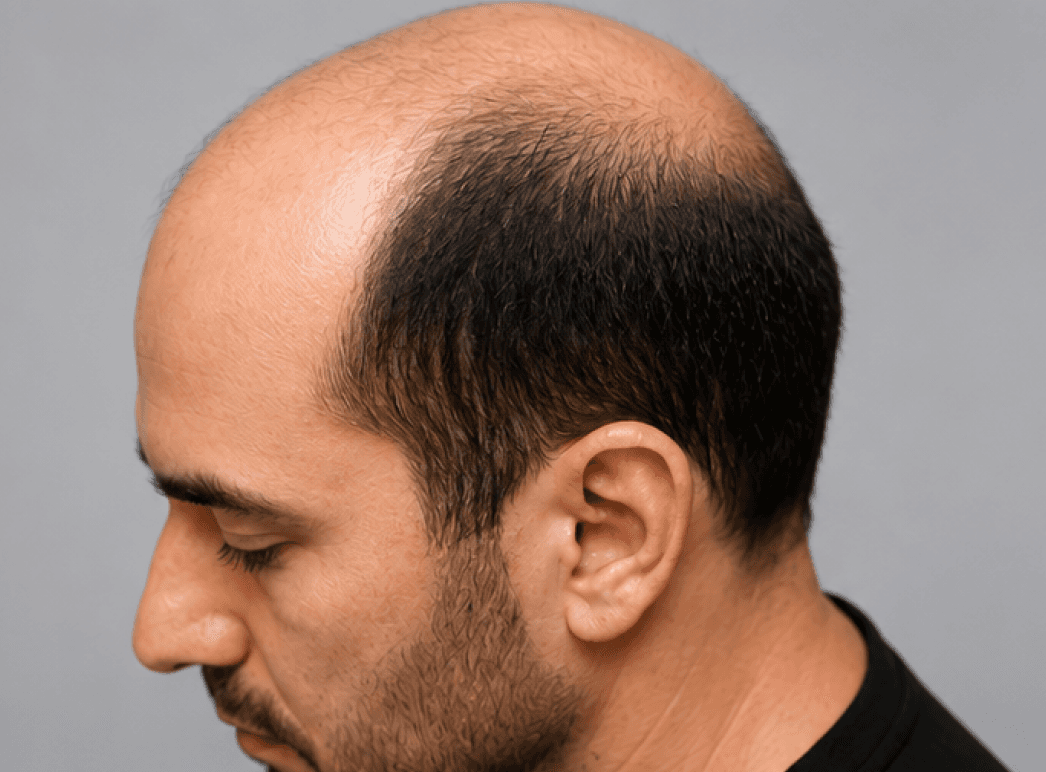
Norwood 6: the bridge has gone and the two areas have merged. See the full Norwood scale.
What Norwood 6 looks like

The top of the scalp
One continuous bald area running from the front hairline back to the crown. The band of hair that separated the two zones at Norwood 5 has thinned away completely. Any hair remaining on top is sparse and fine rather than a meaningful covering.
The sides and back
Hair remains in a band around the sides and the back of the head. At Norwood 6 this band is still reasonably broad and dense in most men, though it has usually begun narrowing at the temples and above the ears compared with earlier stages.

What separates it from Norwood 7
The width and density of that remaining band. At Norwood 6 it is still substantial. At Norwood 7 it has narrowed further and dropped lower around the head, which reduces what is available to work with.
Norwood 6 or Norwood 7?
Both stages look similar from the front. The difference is at the back and sides, and it is the difference that determines what is possible.
Norwood 6
Norwood 7
Top of scalp
One continuous bald area
One continuous bald area
Remaining band
Broad, reasonably dense
Narrower, lower around the head
Temples and above ears
Some narrowing
Substantially receded
Typical graft availability
Usually sufficient for frontal framing
Often limited, assessed case by case
Realistic goal
Frontal framing at moderate density
Depends entirely on donor assessment
How to check
Look at the hair around the sides and back, particularly above the ears and at the temples. If that band is still broad and dense, Norwood 6. If it has narrowed noticeably and sits lower around the head, closer to Norwood 7.
This is genuinely difficult to judge yourself, and unlike the earlier stages a photograph does not settle it, because what matters is density within the band rather than its outline.
How many grafts does Norwood 6 need?
Covering the affected area at Norwood 6 would require roughly 4,000 to 6,000 grafts or more, which is more than many donor areas can safely provide.
That figure is worth stating plainly because it explains why the goal changes at this stage rather than the technique. The bald area at Norwood 6 is large, and the donor supply available to most men is not large enough to cover it at a density that looks natural.
What this means in practice:
A realistic plan is usually smaller than the pattern. Rather than attempting the full area at low density, which tends to look thin and artificial, the supply is concentrated where it does most work.
Donor density decides the ceiling. A man with a dense donor band may have 5,000 or more grafts available across his lifetime. Another with a limited band may have considerably fewer. The pattern on top is identical; the options are not.
Multiple sessions are common. Larger plans are usually staged, which reduces the demand on the donor area at any one time.
Hair characteristics matter more here than anywhere else. Coarse, wavy hair provides substantially more visual coverage per graft, which at this stage can be the difference between a plan working and not.
At Norwood 6 the number that matters is not what the bald area would need. It is what your donor area can safely give. Those two figures are usually far apart, and a plan that ignores the gap produces a thin, artificial result that spends donor hair without achieving much.
Coverage or framing: what a Norwood 6 transplant is actually for
This is the distinction that makes a good result at Norwood 6 possible, and it is worth understanding before any consultation.
Coverage means restoring hair across the whole bald area. At Norwood 6 that is not achievable with a natural appearance, because the area is large and donor supply is finite. Attempting it means spreading grafts so thinly that the result reads as sparse rather than full, and it uses up the entire supply doing so.
Framing means concentrating the available grafts on the front and the mid-scalp behind it, building a defined hairline at a density that looks right for the man's age, and letting the crown remain as it is.
Framing is almost always the better plan. The reason is straightforward: the hairline frames the face and is what people see in ordinary interaction, from the front and in conversation. The crown is seen far less often, and it is the largest, most graft-hungry area on the scalp. Concentrating a limited supply where it is visible produces a result that reads as a full head of hair from the angles that matter, rather than thin hair everywhere.
A Norwood 6 transplant is not a restoration of the hair you had at twenty-five. It is a redistribution of the hair you still have, placed where it does the most work. Any clinic promising full coverage at this stage is either not measuring your donor supply or not telling you what the measurement shows.
There is one more element to an honest answer here, which is age-appropriateness. A hairline designed for a man of sixty should not be the hairline of a man of twenty-five. A low, dense, straight hairline on an older face looks wrong regardless of how well the surgery was performed, and it consumes grafts that would have been better used behind it. A hairline set slightly higher, with a softer, less defined edge, looks natural and uses the supply more efficiently.
Men are sometimes disappointed to hear this. It is nonetheless what produces results that look like hair rather than like surgery.
Treatment options at Norwood 6
Medical treatment
Medical treatment plays a smaller role at Norwood 6 than at earlier stages, because there is little hair remaining on top to protect. It may still be relevant for preserving what remains around the periphery, which matters for the long-term appearance of the transplanted area.
FUT
FUT is frequently the more practical choice at this stage, because it yields a higher number of grafts from the same donor area in a single session. When donor supply is the binding constraint, that difference is meaningful. The trade-off is a linear scar at the back, which should be weighed properly, particularly for men who wear their remaining hair very short.
FUE
FUE avoids the linear scar and remains an option, generally across multiple sessions given the graft numbers involved. For men who keep the sides shaved or very short, the absence of a linear scar can be the deciding factor.
Combined approach
A combined FUT and FUE approach maximises total available grafts and is common at Norwood 6, where the supply constraint is the central problem to solve.
Options other than surgery
Not everyone at Norwood 6 should have a transplant, and it is worth knowing the alternatives properly rather than by default.
Scalp micropigmentation
Pigment applied to the scalp to create the appearance of closely shaved stubble. It does not restore hair, and it works best on men who keep the remaining hair very short. For some men at Norwood 6 it produces a cleaner, more consistent appearance than a transplant would, particularly where donor supply is limited. It can also be used alongside a transplant to add the visual impression of density.
Doing nothing for now
There is no clinical urgency at Norwood 6. The pattern is largely established and the donor supply does not deteriorate on any timetable that requires a decision this month. Taking time is a reasonable choice.
Shaving
Worth saying plainly: a shaved head is a perfectly good outcome, not a failure or a last resort. Many men at Norwood 6 look better with a clean shave than with thin coverage, and it costs nothing, carries no surgical risk, and requires no maintenance beyond a razor.
If you are considering surgery mainly because you feel you ought to rather than because you want it, that is worth examining before spending a finite donor supply on it.
Norwood 6 FAQs
Is Norwood 6 too late for a hair transplant?
No. Most men at Norwood 6 with reasonable donor supply can achieve a good frontal restoration. What changes is the goal rather than the possibility. Full coverage of the bald area is not realistic, while a well-designed frontal framing usually is.
How many grafts do I need for Norwood 6?
Covering the full area would need roughly 4,000 to 6,000 grafts or more, which exceeds what many donor areas can safely provide. Realistic plans concentrate a smaller number on the frontal and mid-scalp areas, often across multiple sessions.
Is a hair transplant worth it at Norwood 6?
It depends on what you expect from it. If the goal is a natural hairline that frames your face at an age-appropriate density, it is frequently worth it. If the goal is the hair you had at twenty-five, it will disappoint you, and that is worth knowing beforehand.
Will my crown be covered at Norwood 6?
Usually not, or only partially. The crown is the largest and most graft-hungry area on the scalp, and where donor supply is limited it is generally better used on the front, which is far more visible in ordinary interaction.
What is the difference between Norwood 6 and Norwood 7?
Both have a continuous bald area on top. The difference is the band of remaining hair at the sides and back, which is broader and denser at Norwood 6 and narrower and lower at Norwood 7. That band determines what is available to transplant.
FUE or FUT at Norwood 6?
FUT yields more grafts from the same donor area in one session, which matters when supply is the constraint, at the cost of a linear scar. FUE avoids the scar and usually means multiple sessions. Men who keep the sides very short often prefer FUE for that reason.
How many sessions will I need at Norwood 6?
Frequently more than one. Staging the work reduces the demand on the donor area at any one time and allows the first result to be assessed before further supply is committed.
Is scalp micropigmentation better than a transplant at Norwood 6?
Neither is universally better. Micropigmentation suits men who keep their hair very short and creates the appearance of stubble rather than restoring hair. A transplant restores real hair but is limited by donor supply. They are sometimes combined.
Can Norwood 6 get worse?
Yes. Loss can continue at the periphery, and the band at the sides and back can narrow further toward a Norwood 7 pattern. This is one reason surgical plans at this stage should account for where the pattern may go rather than only where it is.
Get assessed by Dr.Radha
At Norwood 6 the entire question is what your donor area can supply, and that cannot be judged from a photograph. Two men with identical patterns on top can have very different options depending on the density of the band at the back and sides.
An assessment measures that density under magnification, establishes how many grafts can be taken safely without leaving the donor area visibly thin, and produces a realistic plan: what can be framed, at what density, across how many sessions, and whether surgery is the right choice at all.
Dr. Radha Rani is certified by the American Board of Hair Restoration Surgery and a member of the International Society of Hair Restoration Surgery, with 17 years in hair restoration and over 5,000 procedures. Consultations are available in person in Visakhapatnam and online for patients travelling from elsewhere in India or overseas.


Reviewed by Dr. Radha Rani
Dr. Radha Rani is a hair restoration surgeon based in Visakhapatnam with 17 years in hair transplantation and 25 years in dermatology. She is certified by the American Board of Hair Restoration Surgery and a member of the International Society of Hair Restoration Surgery, and trained under Dr. Damkerng Pathomvanich. She has performed over 5,000 procedures for patients from more than 20 countries.
At IIHT, transformation isn’t just about restoring hair — it’s about restoring you.Take the first step toward a more confident tomorrow.
