
Norwood 7: Is a Hair Transplant Still Possible?
Norwood 7 is the most advanced stage on the Norwood scale. The entire top of the scalp is bald, and the remaining hair forms a narrow band low around the sides and back. Whether a transplant is possible depends entirely on that band: how wide it is, how dense it is, and how much can be taken from it safely. For some men at Norwood 7 a limited frontal restoration is achievable. For others, it is not, and there are better options.
Medically reviewed by Dr. Radha Rani, ABHRS and ISHRS certified hair restoration surgeon. 17 years in hair restoration, 5,000+ procedures.
What it looks like
Your donor area
What is achievable
When surgery is not the answer
Other options
FAQs

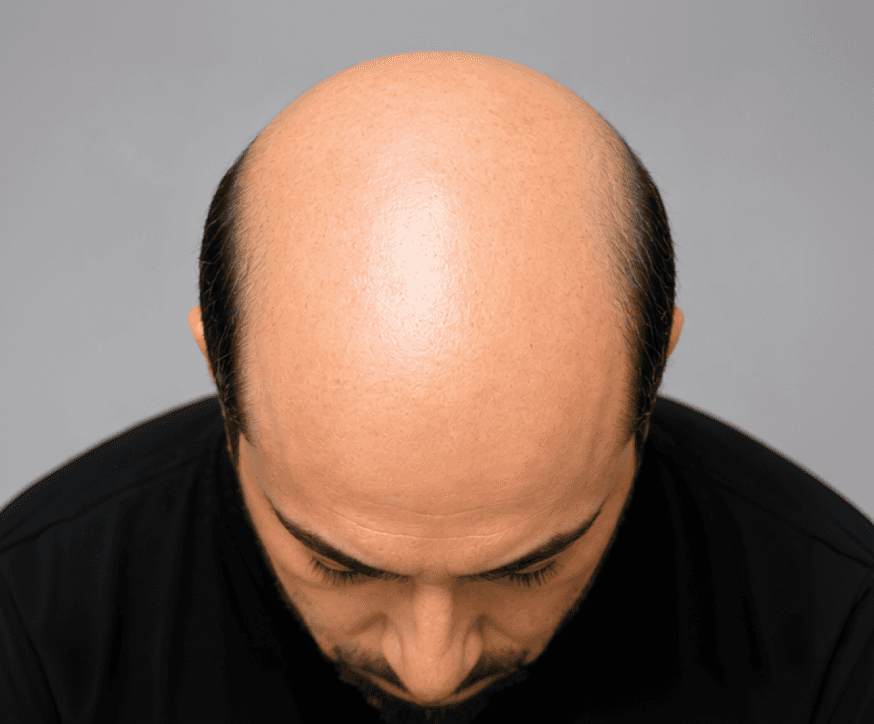
Norwood 7: complete loss on top, with a narrow band of hair remaining around the sides and back. See the full Norwood scale.
What Norwood 7 looks like
The top of the scalp
Completely bald from the front hairline back to the crown, with no meaningful hair remaining anywhere on top.
The sides and back
A band of hair remains, but it is noticeably narrower than at Norwood 6 and sits lower around the head. The band has receded at the temples and above the ears, and it is often thinner at its upper edge, where it borders the bald area.
That upper edge matters clinically. Hair at the boundary is frequently less stable than hair lower down, which reduces the portion of the band that can be used safely.


What varies between men
A great deal. Two men both correctly classified as Norwood 7 can have quite different amounts of usable hair depending on how broad the band is, how dense it is, and how much of it sits within the genuinely stable zone. This variation is why the answer to the transplant question cannot be given from a photograph.
Why the answer depends on the back of your head
At every stage of the Norwood scale, donor supply matters. At Norwood 7 it is the only thing that matters.
A transplant relocates hair. It does not create it. With the entire top of the scalp bald, the question is no longer where to place grafts but whether there are enough of them to place, and whether taking them would leave the donor area looking worse than it does now.
The safe donor zone at Norwood 7
Hair within a band around the back and sides is genetically resistant to the process that caused the loss. At earlier stages this zone is broad and taking from it is straightforward. At Norwood 7 the zone is narrower, and its upper boundary has often already begun to thin.
That means less of the visible remaining hair is actually usable than it appears. Grafts taken from the unstable upper edge may themselves thin later, leaving the transplanted result without a stable foundation and the donor area visibly sparse.
Why over-harvesting is the risk here
At earlier stages, over-harvesting produces a donor area that thins over time. At Norwood 7 it can produce a visibly patchy or moth-eaten back and sides, which is difficult to disguise precisely because that band is the only hair remaining. It is not a correctable outcome. This is the reason a careful surgeon is conservative at this stage, and sometimes declines.
How much is usually available
It varies too widely to give a useful general figure, which is itself the honest answer. Some men at Norwood 7 with a dense, broad band may have enough for a limited frontal restoration. Others have substantially less available, and taking it would compromise the appearance of the donor area for a result that would not achieve much.
What a transplant can achieve at Norwood 7
Where donor supply allows it, the realistic goal is a limited frontal restoration: a hairline and some depth behind it, framing the face, at a modest density appropriate to the man's age.
That is worth being precise about, because it is a smaller intervention than most people picture.
The crown is not covered. There is no realistic scenario at Norwood 7 where the crown is restored. The available supply goes to the front or it does not go anywhere useful.
Density is modest. The aim is the appearance of hair rather than the density of a full head. Set against a completely bald scalp, even modest density at the front makes a substantial difference to how a face reads.
The hairline sits higher. A conservative, higher hairline with a soft edge suits both the age of most Norwood 7 patients and the supply available. A low, dense hairline would consume the entire supply on a strip of hair and look wrong on the face behind it.
It may take more than one session. Staged work reduces demand on a narrow donor area.
At Norwood 7 the realistic question is not how much hair can be restored. It is whether the amount that can safely be moved would make enough difference to be worth the surgery, the cost, and the permanent spending of your remaining donor supply. For some men the answer is yes. For others it is not, and that is a legitimate finding rather than a disappointing one.
When a transplant is not the right answer
Some men at Norwood 7 should not have a hair transplant. It is worth stating that plainly, because it is not what most clinic websites will tell you.
The circumstances where surgery is unlikely to serve you well:
When the donor band is too narrow or too sparse. If the safe zone cannot provide enough grafts for a result that reads as hair, taking them achieves little and leaves the donor area worse. Spending a finite, non-renewable supply on a result that will not satisfy you is the wrong trade.
When the expectation is coverage. If what you want is your hair back, or the top of your head covered, no surgeon can deliver that at Norwood 7. A man who proceeds expecting coverage will be disappointed by a result that was, technically, a success.
When the donor edge is unstable. If the upper boundary of the remaining band is still thinning, the pattern may not be finished. Taking from it now risks both a poor donor appearance and a transplanted result sitting above hair that later disappears.
When shaving suits you. Some men look better with a clean shave than with modest frontal density. That is not a consolation, it is an aesthetic judgement, and it is worth making honestly before committing to surgery.
A surgeon who tells you that a transplant would not serve you well at Norwood 7 is not dismissing you. Donor hair is finite and cannot be replaced. Declining to spend it on a result that will not satisfy you is the more careful decision, not the less helpful one.
If a clinic looks at a Norwood 7 patient and proposes a large procedure without a detailed donor assessment, or promises coverage of the top of the scalp, that is worth weighing carefully. At this stage more than any other, the quality of the assessment matters more than the quality of the surgery.
Options other than a transplant
Where surgery is not suitable, or where you decide against it, there are alternatives worth knowing properly.
Scalp micropigmentation
Pigment applied to the scalp to create the appearance of closely shaved stubble across the bald area. It restores no hair, but at Norwood 7 it can be particularly effective, because it works with a shaved or very short remaining band rather than against it. The result is a consistent, clean appearance rather than a partial one. For many men at this stage it produces a better overall look than a limited transplant would.
Combining approaches
Where a limited transplant is possible, micropigmentation is sometimes used alongside it to add the visual impression of density behind the transplanted hairline. This can stretch a limited donor supply further than surgery alone.
Shaving
A clean-shaven head is a legitimate and often excellent outcome at Norwood 7, not a fallback. It costs nothing, carries no surgical risk, requires no donor hair, and for a great many men it simply looks good. If you have been assuming a transplant is the goal because it is what clinics sell, this is worth genuinely considering rather than defaulting past.
Body hair transplantation
In selected cases, hair from the beard or chest can supplement scalp donor supply. It is not a substitute for scalp donor hair, the characteristics differ, and it is only appropriate in specific circumstances. If it is raised, it should come with a clear explanation of the limitations rather than as a way of making an unsuitable case sound viable.
Norwood 7 FAQs
Can you get a hair transplant at Norwood 7?
Sometimes. It depends entirely on the width and density of the remaining band at the sides and back, and how much of it sits within the stable donor zone. Some men at Norwood 7 can have a limited frontal restoration. Others do not have enough usable supply.
Is Norwood 7 hopeless?
No, though the realistic options are different from earlier stages. A limited frontal restoration is possible for some men, scalp micropigmentation suits many, and a clean shave is a genuinely good outcome for a great many others. What is not available at Norwood 7 is coverage of the top of the scalp.
How many grafts are available at Norwood 7?
It varies too widely to give a general figure, which is itself the point. The number depends on the width and density of your remaining band and how much of it is stable. Only an examination under magnification can establish it.
Will my crown be covered at Norwood 7?
No. Where surgery is possible, the available supply goes to the frontal area, which frames the face and makes the greatest visible difference. There is no realistic scenario at this stage in which the crown is restored.
Why would a surgeon refuse to operate at Norwood 7?
Because donor hair is finite and cannot be replaced. If the available supply would not produce a result worth having, or if taking it would leave the donor area visibly patchy, declining is the more careful decision. Over-harvesting at this stage is not correctable.
Is scalp micropigmentation better than a transplant at Norwood 7?
For many men at this stage, yes, because it produces a consistent appearance across the whole scalp rather than a partial one, and it uses no donor hair. It creates the look of shaved stubble rather than restoring hair, so it suits men who keep their remaining hair short.
Can beard or body hair be used?
In selected cases it can supplement scalp donor supply. The hair characteristics differ from scalp hair and it is not a substitute for an adequate donor area. It should only be considered with a clear explanation of its limitations.
Is it too late for medication at Norwood 7?
Medication will not restore hair that has already been lost, and at Norwood 7 there is little remaining on top to protect. It may occasionally be relevant for preserving the periphery, but it is not a meaningful treatment for the pattern at this stage.
What should I ask a clinic at Norwood 7?
Ask how they assessed your donor density, how many grafts they consider safely available, what specifically they expect the result to look like, and what happens to the appearance of your donor area afterwards. A clinic that answers those precisely is one worth taking seriously.
Get assessed by Dr.Radha
At Norwood 7 the assessment is entirely about the back and sides. Nothing visible from the front changes the answer.
It measures the density of the remaining band under magnification, establishes how much of it sits within the genuinely stable zone, determines how many grafts could be taken without leaving the donor area visibly sparse, and answers the actual question: whether the amount that can safely be moved would produce a result worth having.
That answer is sometimes no. A consultation that reaches that conclusion honestly has still been worth having, because it saves you from spending a finite supply on a result that would not have satisfied you.
Dr. Radha Rani is certified by the American Board of Hair Restoration Surgery and a member of the International Society of Hair Restoration Surgery, with 17 years in hair restoration and over 5,000 procedures. Consultations are available in person in Visakhapatnam and online for patients travelling from elsewhere in India or overseas.


Reviewed by Dr. Radha Rani
Dr. Radha Rani is a hair restoration surgeon based in Visakhapatnam with 17 years in hair transplantation and 25 years in dermatology. She is certified by the American Board of Hair Restoration Surgery and a member of the International Society of Hair Restoration Surgery, and trained under Dr. Damkerng Pathomvanich. She has performed over 5,000 procedures for patients from more than 20 countries.
At IIHT, transformation isn’t just about restoring hair — it’s about restoring you.Take the first step toward a more confident tomorrow.
